ABOUT
Low-Dimensional Magnetic and Topological Materials
TOPOMAG LAB is an experimental research laboratory dedicated to the synthesis, characterization, and physical investigation of topological insulators and magnetic materials. The lab explores how electronic topology, magnetism, and lattice distortions interplay in solid-state systems, aiming to uncover novel quantum and magneto-mechanical phenomena in condensed matter physics.
The research activity of TOPOMAG LAB is organized around two main experimental directions, closely connected by common physical concepts and methodologies.
- Topological Insulator Materials and Magnetic Doping
One core research direction focuses on topological insulator materials, including systems modified by magnetic doping or magnetic proximity effects. The lab experimentally investigates how magnetic order alters electronic and surface states, breaking time-reversal symmetry and giving rise to new physical behavior. Particular emphasis is placed on identifying magnetically gapped surface states, topological phase transitions, and emergent magneto-transport phenomena.
By combining material synthesis with advanced characterization techniques, TOPOMAG LAB studies the role of dopants, disorder, strain, and dimensionality in controlling topological and magnetic properties. These investigations contribute to ongoing efforts to realize and understand magnetic topological phases in experimentally accessible material platforms.
- Equilibrium crystals
150 years later On the Equilibrium of Heterogeneous Substances, core work (1875–1878) of J. Willard Gibbs.
Nucleation is a universal phenomenon in science and the natural world. It plays a key role across sciences and technologies from geology, physics and chemistry and in industrial processes like setting of concrete and manufacturing drugs.
Nucleation plays a key role in the initial stage of thin film formation, acting as the primary determinant of a film's final microstructure, morphology, and, consequently, its physical and functional properties. It involves the transition from dispersed atoms/molecules on a substrate to the formation of stable, ordered clusters (nuclei).
The nucleation and growth processes occurring in thin film formation with three main growth modes occurs e.g. Volmer–Weber (3D islands), Frank–van der Merwe (layer-by-layer growth), and Stranski–Krastanov (layer-plus-island), based on the balance of surface energies between the film, the substrate, and the interface.
Around melting temperature, during bismuth Volmer–Weber growth crystals tend to have shapes, which are pretty round not a complete sphere, but with no regions, which are flat (faceted). This is because at high temperature the atoms on the surface vibrate because they have so much energy to spare. The facets appear at lower temperatures, as the crystals are cooled: the first temperature at which a facet occurs is called the roughening temperature. The facets start out small and close to the special directions; as the temperature goes down, they become larger. The equilibrium crystal shape show sharp edges and corners with clear facets.
Cite This: https://dx.doi.org/10.1021/acsanm.0c01650
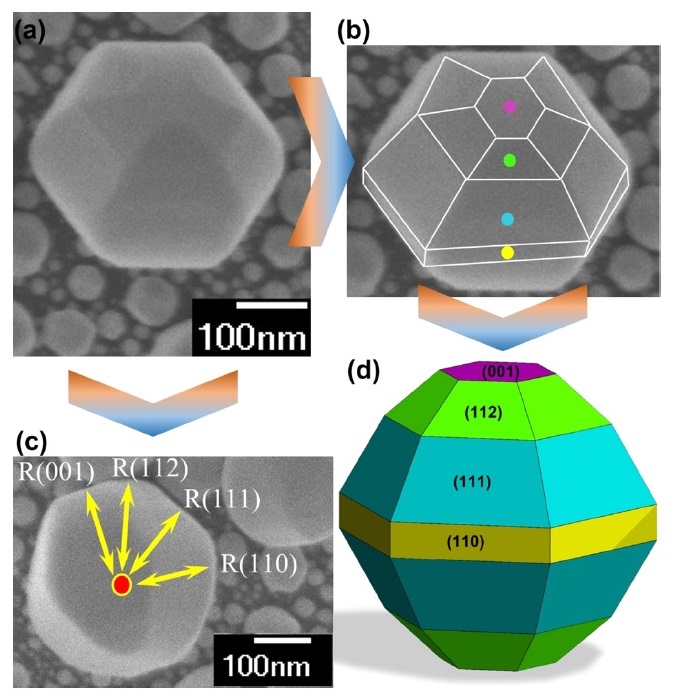
Figure: (a) FESEM image of an equilibrated Bi crystal. (b) The same crystal with outlined edges and colored planes. (c) Distances of the facets from the Wulff center at an equilibrium crystal detected at a 90° rotation (side view). (d) Corresponding representation of the Wulff shape of the crystal in Wulffmaker.
- Magnetic Materials and Flexomagnetism
A second major research direction addresses magnetic materials and magnetism-driven effects, with a particular focus on flexomagnetism — the coupling between magnetic properties and strain gradients. TOPOMAG LAB experimentally explores how mechanical deformation, lattice distortions, and structural inhomogeneities influence magnetic order and spin-dependent responses.
This research encompasses the study of bulk and low-dimensional magnetic systems, where strain engineering and mechanical control offer new avenues for manipulating magnetism. Flexomagnetism serves as a unifying theme linking mechanical and magnetic degrees of freedom, with potential applications in sensors, actuators, and mechanically controlled spintronic devices.
- Experimental Approach
TOPOMAG LAB employs a broad range of experimental techniques for materials growth and characterization, including structural, magnetic, and transport probes. Experimental studies are supported by close interaction with theoretical modeling and first-principles calculations, allowing for a comprehensive interpretation of observed phenomena.
Overall, TOPOMAG LAB advances the experimental understanding of topological insulators, magnetic materials, and flexomagnetic effects, contributing to the discovery of new physical mechanisms and functional properties in novel magnetic and quantum materials.
- Selected publications
Shubnikov-de-Haas oscillations in topological insulator Bi2Se3 single crystals MSEB 2025
Sustainability for EL65, (2024) https://doi.org/10.5281/zenodo.20271292
Microfabricated Gold Aptasensors for the Label-Free Electrochemical Assay of Oxytetracycline Residues in Milk, MDPI Eng Proc 58(1) 1 (2023).
Micrometer thick Sm-Co films for applications on flexible systems, Materials Science and Engineering: B 280 115691 (2022).
Magnetic-field-free spin-orbit torque driven magnetization
dynamics in CoFeB/β-W based nanoelements, AIP Advances 12, 015123 (2022).
Magnetotransport Phenomena in Topological Insulator / Superconductor Bi2Te3/Nb Bilayer and Trilayer Thin Films, Accepted IEEE Xplore May 2021.
Evaluating the multifunctional performance of polymer matrix nanodielectrics incorporating magnetic nanoparticles: A comparative study, Polymer 236 (2021) 124311
Villari magnetomechanical coupling at hcp-Cobalt thin films on flexible substrates, Materials Science and Engineering B: Solid-State Materials for Advanced Technology, Volume 264, February 2021, Article number 114945.
High Layer Uniformity of Two-Dimensional Materials Demonstrated Surprisingly from Broad Features in Surface Electron Diffraction, Journal of Physical Chemistry Letters, Volume 11, Issue 21, 5 November 2020, Pages 8937-8943.
Nanometer-thick bismuth nanocrystal films for sensoric applications, ACS Applied Nano Materials Volume 3, Issue 10, 23 October 2020, Pages 9669-9678.
Anomalous hall effect in a magnetic topological insulator (BiMn)2Te3 (2019) IEEE Transactions on Magnetics, 55 (7), art. no. 8662784.
Scholarships and Awards
Dr. Thsnassis Speliotis was awarded the following scholarships and awards:
- DAAD Scholarship, HZDR – Helmholtz-Zentrum Dresden-Rossendorf, Germany. (2024-2025)
- DAAD Scholarship, HZDR – Helmholtz-Zentrum Dresden-Rossendorf, Germany. (2020 – 2021)
- Fulbright Scholarship, College of Liberal Arts and Sciences/Department of Physics and Astronomy/Ames National Laboratory, Iowa State University USA (2019 – 2020)
- Fulbright Scholar for the Academic Year 2019-2020, The Fulbright Foundation, Athens, Greece. (2019 – 2020).
Service to Society
Dr. Thsnassis Speliotis has also served as a member of the following scientific Councils:
2020 – 2022: Member of the Sectoral Scientific Council (SSC) for "Natural Sciences and Mathematics" of the National Council for Research, Technology and Innovation (NCRTI). This was an unpaid position held in the public interest.
2022 – 2026: Member of the Regional Council for Research and Innovation (RCRI) of the Peloponnese Region. Government Gazette, November 3, 2022, Issue 1028. This is an unpaid position held in the public interest.
Current group members:
Dr. Thanassis Speliotis
Email: t.speliotis@inn.demokritos.gr, Tel: 2106503383
Phd Candidates
Nikolaos Koutsokostas
PhD Candidate, School of Chemical Engineering, National Technical University of Athens, Greece
Email: n.koutsokostas@inn.demokritos.gr, Tel: 2106503355
Website: https://www.researchgate.net/profile/Nikolaos-Koutsokostas
Zoi Plevri
PhD Candidate, School of Applied Mathematical and Physical Sciences, National Technical University of Athens, Greece
Email: z.plevri@inn.demokritos.gr, Tel 2106503355
Website: https://www.researchgate.net/profile/Zoi-Plevri
Other Students:
Anhela Abazi, Tel: 2106503355
Master's Program Student of Physics and Astronomy Department, University of Victoria, Canada
Email: b.myrto@yahoo.com
Alumna:
Dr. Alexandra Pilidi
Email: a.pilidi@inn.demokritos.gr
Former group members:
Manos Zeibekis, Postdoctoral Researcher, Research Program “Kripis”.
Athanasios Tzanis, Post-graduate Student, NTUA/School Of Chemical Engineering
Livanina Moukatzi, Post-graduate Student, NTUA/School Of Applied Mathematical and Physical Sciences
Alexios Melitsiotis, Post-graduate Student, NTUA/ School Of Applied Mathematical and Physical Sciences
Panagiotis Athanasopoulos, Post-graduate Student, NTUA/ School Of Applied Mathematical and Physical Sciences
- TOPOMAG LAB as a Living Lab
TOPOMAG LAB operates as a living lab by uniting theory, material synthesis, advanced characterization, and device prototyping in a real-world experimental environment. Through continuous interaction with academic and industrial stakeholders, the lab enables rapid co-creation and validation of magnetic and topological materials under operational conditions, accelerating the transition from fundamental discovery to innovative technologies.