
Molecular Magnetic Materials
Molecule based magnetic materials constitute an alternative approach towards the realization of novel systems with specific technological applications. Synthetic oligo- and poly-nuclear inorganic complexes of transition metals and lanthanides constitute an important class of these materials. The fields of applications include among others:
-Magnetic Storage
-Magnetic Cooling
-Sensors
-Quantum Computing
We are interested in determining the key factors that govern the behavior of these compounds. Our methodology is based on the application of spectroscopic techniques such as Electron Paramagnetic Resonance (EPR) and Mössbauer Spectroscopy as well as the application of static and dynamic magnetic measurements.
In the following we present characteristic examples from our activity:
- Determination of the oxidation and electronic state of the transition metal ions.
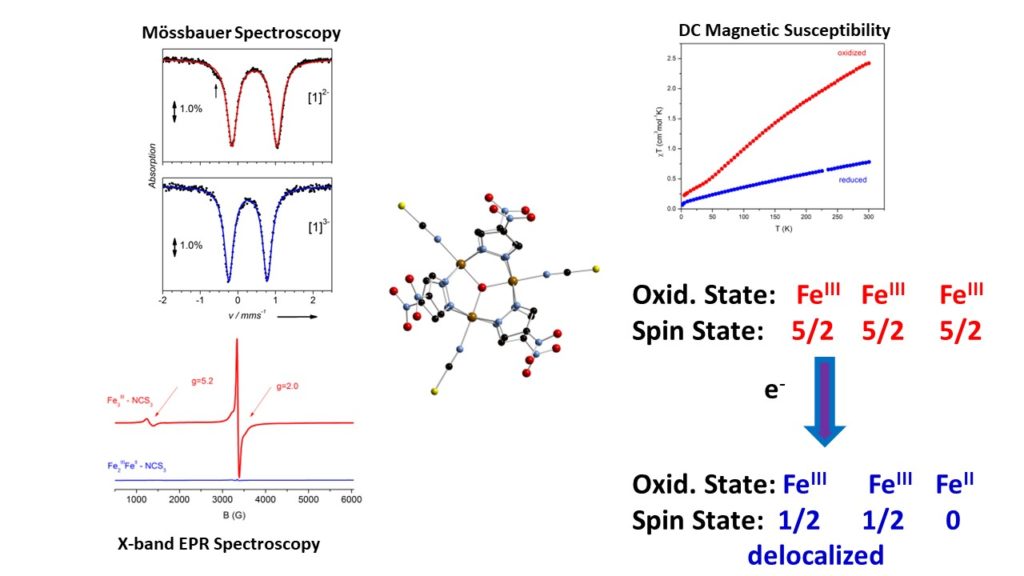
We studied the trinuclear ferric cluster [Fe3(μ3-O)(μ-4-NO2-pz)6(NCS)3]2–, [12–], The Mössbauer spectrum at 80 K gives rise to a quadruple doublet with parameters consistent with three equivalent high spin ferric ions in an octahedral environment comprising N/O ligands. Variable temperature magnetic susceptibility measurements indicate antiferromagnetic coupling. EPR spectroscopy at liquid helium temperatures gives rise to a strong EPR signal at g = 2.0 consistent with and S = 1/2 state. In the one electron reduced state the Mössbauer spectrum at 80 K comprises one doublet consistent with a fully delocalized system comprising two Fe3+(S=1/2) and one Fe2+(S=0) ions. EPR and magnetic susceptibility studies indicate that the mixed - valence trinuclear cluster is characterized by a diamagnetic ground state. The experimental observations are supported by theoretical calculations. Therefore, one-electron reduction of the Fe3(m3-O) core induces a cascade wherein all three metal centers switch from high-spin Fe3+ to low-spin Fe2.66+ where the injected electron delocalizes over the three iron ions.
Ref:
Angew. Chem. Int. Ed. 56, 582 (2017). doi: 10.1002/anie.201610534
-Dependence of spectroscopic parameters upon the coordination environment (symmetry, coordination number) of transition metal ions.
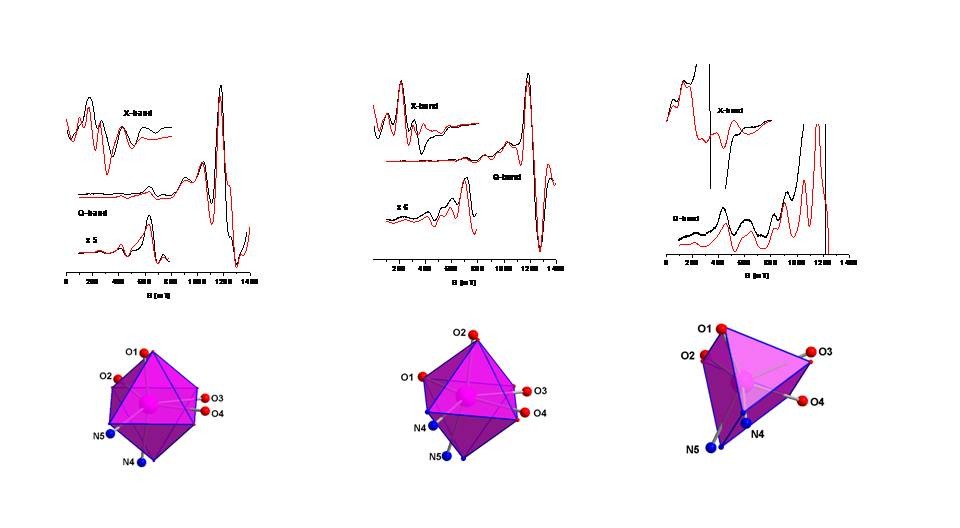
X- and Q-band EPR spectroscopy was applied to study the electronic properties of the [Mn(O,O)(N,N)(NO3)] complexes, (O,O) = [PhC(O)NP(O)PPh2]-, (N,N) = phenanthroline (1), neocuproine (2) and 2,2¢-bipyridine (3). In 1 and 2 the Mn(II) ion is closer to an octahedral environment, whereas in 3 the symmetry is closer to trigonal prismatic. Analysis of the EPR spectra determined the zero-field splitting parameters of these S = 5/2 systems and revealed a small but significant difference in the magnitude of |D| for complex 3 compared to those of 1 and 2. These differences are attributed to the structural and electronic properties of complexes 1-3. The latter were probed by DFT calculations, which showed different DSOC contributions among the three complexes.
Ref:
Polyhedron, 207, 115234 (2021). doi: 10.1016/j.poly.2021.115374
-Determination of the exchange coupling scheme in polynuclear transition metal clusters. The role of non isotropic exchange interactions in exchange coupled systems.
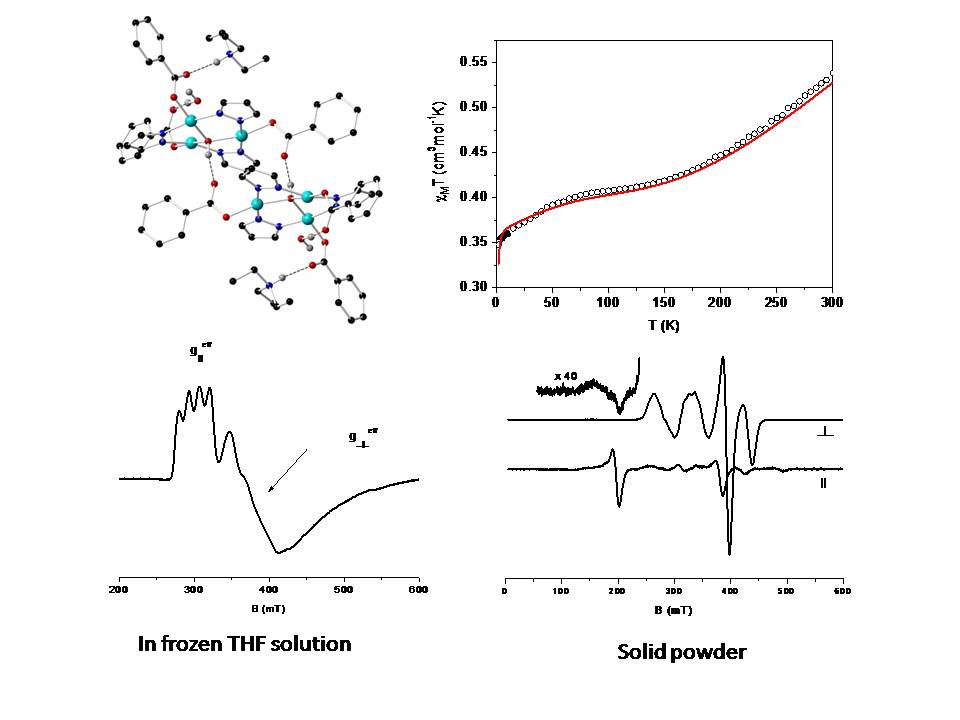
The complex [Cu3(m3-OH)(m-pz)3(PhCOO)3]_ (pz_ = pyrazolato anion) shows an isosceles triangular core, further forming a hexanuclear H-bonded aggregate. Analysis of variable temperature magnetic susceptibility data of a powder sample shows an antiferromagnetically-coupled Cu3-core with a doublet ground state. The fitting of magnetic data requires the inclusion of antisymmetric exchange, AE (HAE = GijSi x Sj). X-band EPR spectroscopy in a frozen tetrahydrofuran solution of the compound indicates isolated Cu3-species suggesting cleavage of the H-bonds in solution. The small value of g^,eff (<<2.0) is consistent with the presence of AE in agreement with the analysis of the magnetic measurements. EPR spectra were performed with powder samples of the cluster at liquid helium temperatures. The spectra are consistent with two interacting Sa,b = 1/2 species in the point dipolar approximation. From the analysis of the EPR spectra in the solid state an inter-spin distance of 4.4–4.5 Å was deduced which is very close to the distance between the Cu(1) and Cu(1)' sites of the two trimeric units as imposed crystallographically (4.3 Å).
Ref:
Phys. Chem. Chem. Phys. 20, 17234 (2018). doi: 10.1039/c8cp02643b
-Spin relaxation properties of mononuclear transition metal complexes.
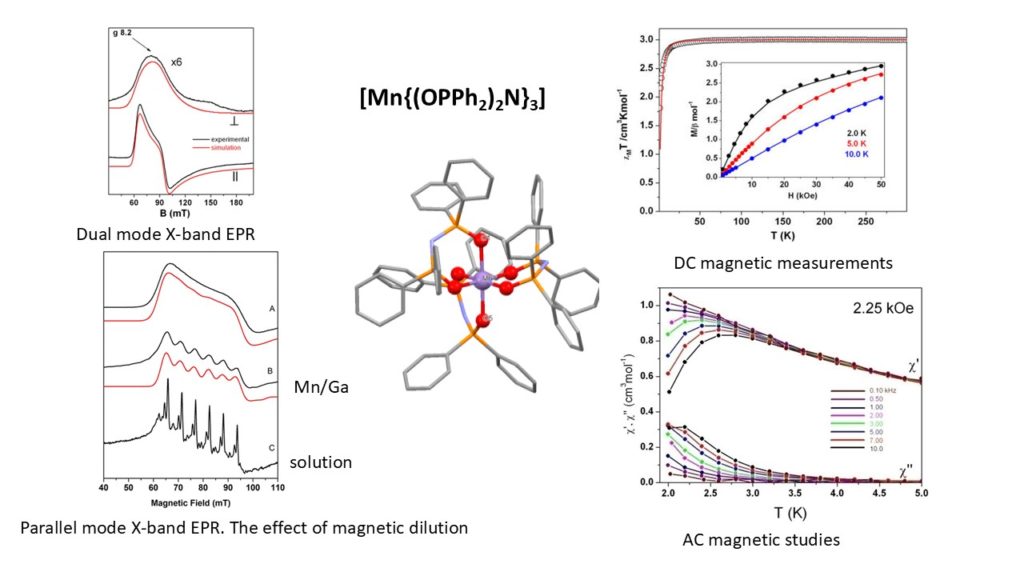
The spin relaxation properties of mononuclear transition metal and lanthanides ions complexes constitute an active field of research related to molecular magnetism in the last years. We studied the relaxation properties of the mononuclear complex, [Mn{(OPPh2)2N}3] where [(OPPh2)2N]— the tetraphenylimidodiphosphinato ligand. In this complex, the MnIII ion is found in a MnO6 coordination sphere exhibiting a Jahn-Teller distortion with an elongation axis. EPR spectroscopy (in the figures we show a representative EPR spectrum recorded at X-band in parallel mode) indicates that the complex is characterized by a negative zero field splitting parameter, D. Moreover, EPR spectroscopy implies the involvement of fourth order terms. The experimentally determined zero field parameters are in agreement with theoretical calculations. The compound was shown to exhibit slow spin relaxation in the presence of an external dc magnetic field. Upon magnetic dilution with Ga ions the EPR become better resolved and remarkably narrow lines are observed in frozen solutions. Studies with magnetic diluted samples indicate that the relaxation properties are inherent to the complex. The compound was one of the first S = 2 Mn(III) mononuclear complexes where slow magnetic relaxation behavior was reported.
a. Inorg. Chem. 52, 12869 (2013). doi: 10.1021/ic402042e
b. Inorg. Chem. 59, 13281 (2020). doi: 10.1021/acs.inorgchem.0c01636
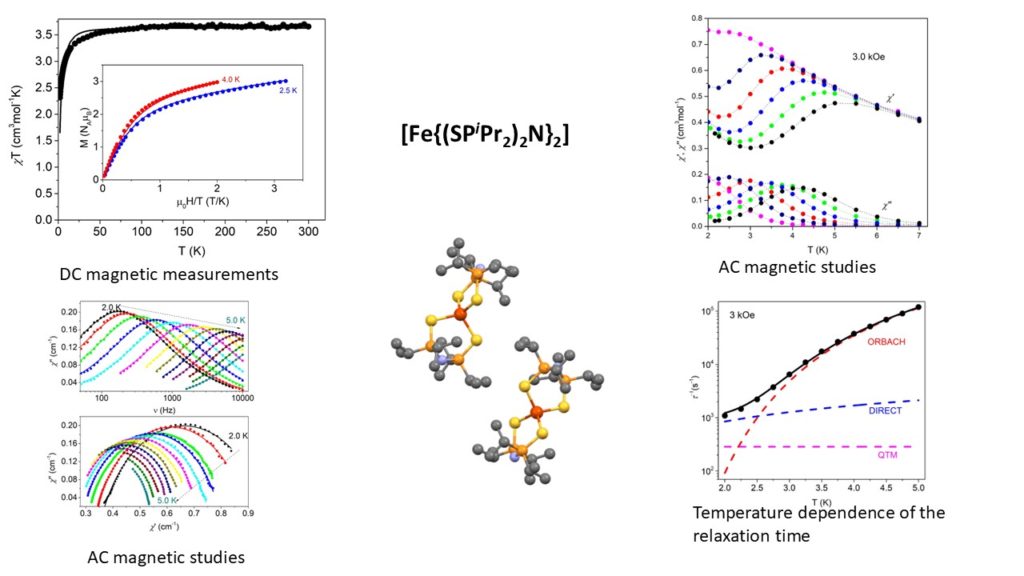
The spin relaxation properties of the mononuclear tetrahedral S = 2 [Fe{(SPiPr2)2N}2] complex (1) were studied by employing static and dynamic magnetic measurements al liquid helium temperatures. In the absence of an external direct current (DC) magnetic field, 1 exhibits fast magnetic relaxation. However, in the presence of external magnetic fields of a few kOe, slow relaxation is induced as monitored by alternating current (AC) magnetic susceptibility measurements up to 10 kHz, in the temperature range 2-5 K. Analysis of the temperature dependence of the corresponding relaxation time reveals contributions by the Quantum Tunnelling of Magnetization, and the Direct and Orbach processes in the magnetization relaxation mechanism of 1. To our best knowledge, complex 1 is the first very close to tetrahedral Fe(II) complex the dynamic magnetic properties of which have been studied up to date.
Refs:
a. ChemPlusChem 89, e202400109 (2024). doi.org/10.1002/cplu.202400109
-Spin relaxation properties of oligonuclear transition metal complexes.
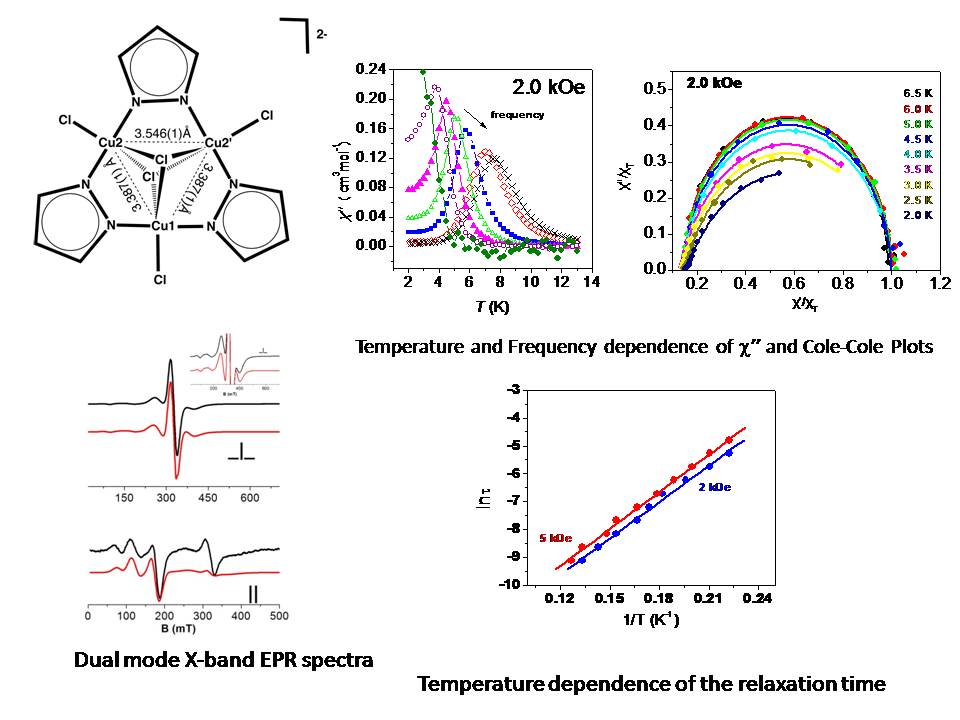
The trinuclear complex [Bu4N]2[Cu3(μ3-Cl)2(μ-pz)3Cl3] exhibits ferromagnetic interactions leading to an S = 3/2 ground state. EPR spectroscopy indicates that the ground state is characterized by a positive almost axial zero field splitting term of the order of 0.1 cm-1. No significant magnetic relaxation properties are expected due to the small spin value of the ground state and the negligible (and positive) zero field splitting parameter. Indeed, dynamic magnetic measurements in the absence of an external dc magnetic field indicate the absence of slow magnetic relaxation. However, a remarkable relaxation behavior is observed in the presence of an external dc magnetic field. The relaxation follows an Orbach mechanism with a barrier that relates to the S=3/2 ground and S = 1/2 excited manifolds.
Ref:
Chem. Phys. Lett. 493, 185 (2010). doi: 10.1016/j.cplett.2010.05.011
-Electron hoping in mixed valence systems.
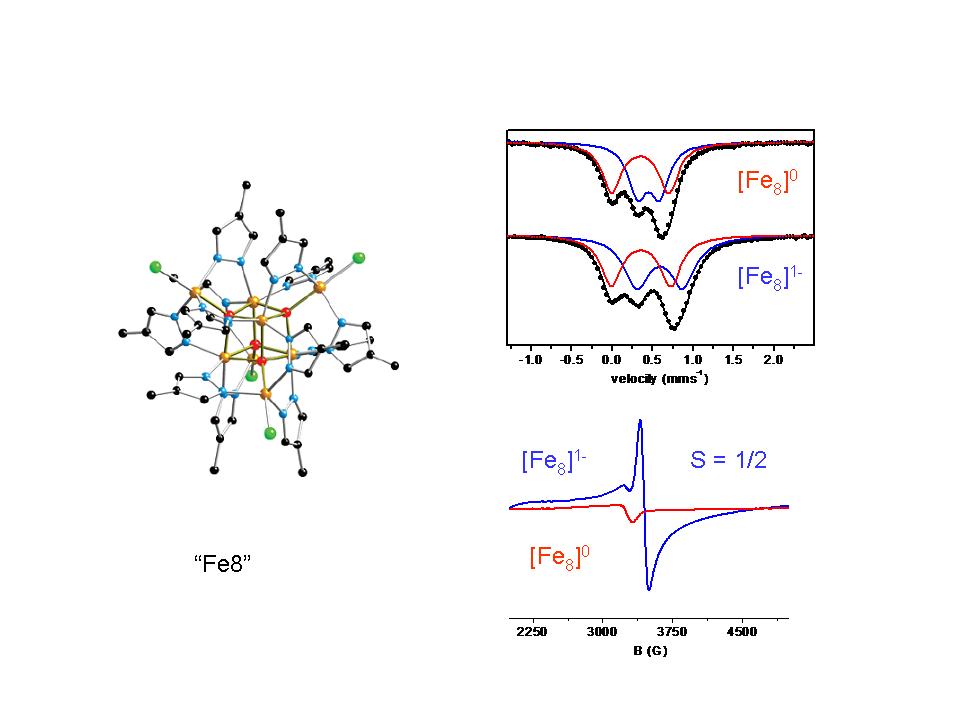
The clusters described by the general formula [Fe8(µ4-O)4(µ-4-R-pz)12X4] (pz = pyrazolato anion, C3H3N2–) (Fe8) contain a central Fe4(µ4-O)4-cubane surrounded by four additional Fe-centers. The terminal X- ligands are coordinated to the latter, forming a Fe8(µ4-O)4X4-core with tetrahedral geometry.The outer irons (Feo) have a trigonal bipyramidal coordination sphere whereas the FeIII centers in the cubane (Feo) have pseudo-octahedral geometries. The all ferric cluster exhibits a characteristic Mössbauer spectrum comprising two doublets the parameters of which reflect the different coordination environment (six vs five coordination). At this stage the cluster is EPR silent. Upon one electron reduction a cluster with nominal oxidation state Fe7IIIFeII is formed. Mössbauer spectroscopy indicates that the extra electron is delocalized over the iron sites of the cubane. At 4.2 K a characteristic EPR spectrum is revealed indicating that the ground state is characterized by S = 1/2.
Refs:
a. Inorg. Chem. 47, 11734 (2008). doi: 10.1021/ic801459s
b. Inorg. Chem. 50, 1021 (2011). doi: 10.1021/ic101691q
c. Dalton Trans. 43, 11269 (2014). doi: 10.1039/c4dt00020j
-Site occupation and preference in heterometallic clusters.
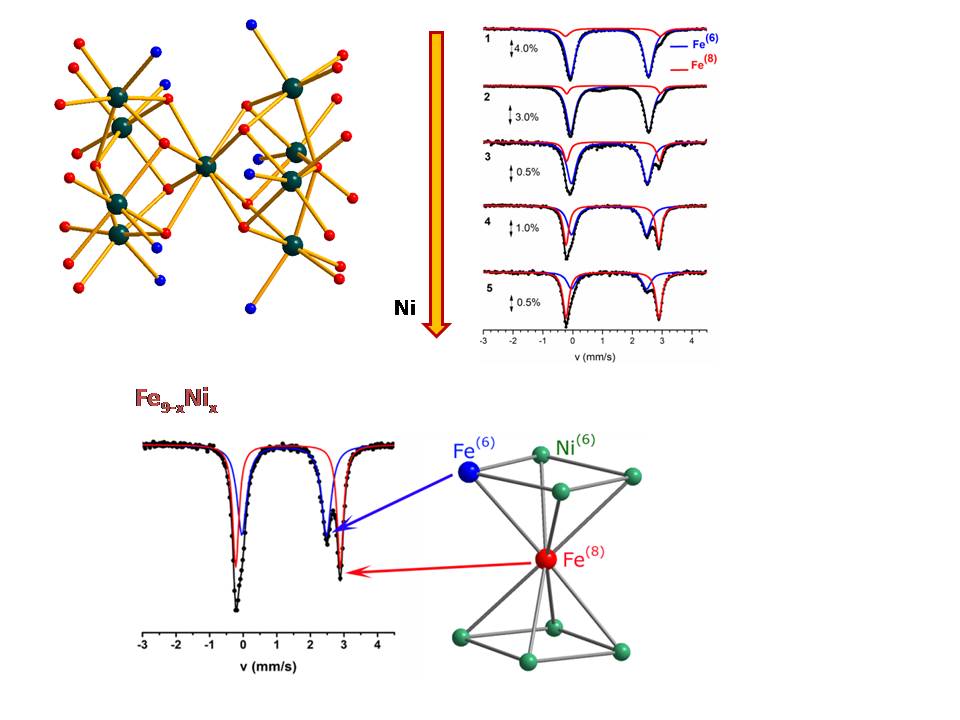
The reaction of mixtures of Fe(O2CMe)2∙2H2O and Ni(O2CMe)2∙4H2O of various compositions with di-2-pyridyl ketone afforded a family of hetero-metallic enneanuclear clusters with general formula [Fe9-xNix(µ4-OH)2(O2CMe)8(py2CO2)4] (Fe9-xNix; x = 0 - 8). All clusters contain a central MII ion in an unusual 8-coordinate site and eight peripheral MII ions in distorted octahedral environments. The all-iron complex exhibits a Mössbauer spectrum comprising two doublets at a 8:1 ratio with parameters that reflect the different coordination number of the ferrous ions: the majority species is attributed to the 6-coordinate ferrous ions whereas the minority species is assigned to the unique 8-coordinate site. A characteristic dependence on the NiII content of the ratio between the doublets is observed. With increasing Ni, the 8-coordinate ferrous doublet increases at the expense of the 6-coordinate ferrous doublet implying that as the Ni content increases Fe tends to occupy the 8-coordinate site. Theoretical calculations indicate that this behavior reflects the tendency of NiII ions to occupy octahedral sites. Site occupancy and preference are very common issues in inorganic mixed metal oxides and the present study shows that similar phenomena can be observed and studied in molecular clusters.
Refs:
Dalton Trans. 46, 12835 (2017). doi: 10.1039/c7dt02930f
-Heterometallic 3d/4f clusters
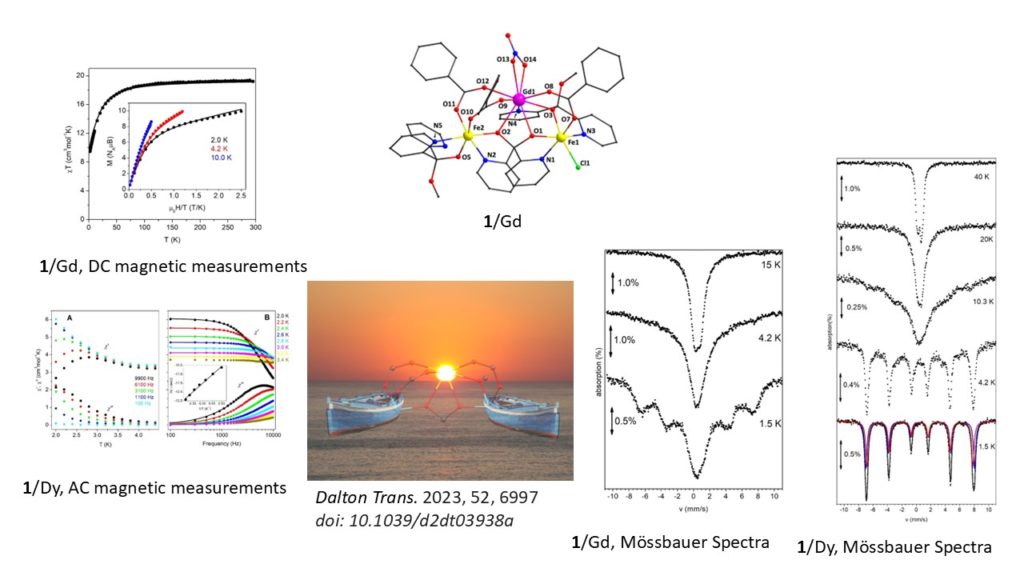
Heterometallic 3d/4f polynuclear clusters constitute a family of compounds with properties relevant to molecular magnetism or they can be found as constituents of Metal Organic Frameworks. Here we study a new family of trinuclear heterometallic Fe3+/Ln3+ complexes, [Fe2Ln(PhCO2)3((py)2CO2) ((py)2C(OMe)O)2(NO3)Cl] (Ln = Gd (1/Gd), Tb (1/Tb), Dy (1/Dy), and Ho (1/Ho)), where (py)2CO22− and (py)2C(OMe)O− are the anions of the gem-diol and hemiketal derivatives of di-2-pyridyl ketone. Compounds 1/Ln are based on an asymmetric “V-shaped” [Fe3+(μ-OR)Ln(μ-OR)2Fe3+]6+ structural core formed from the connection of the two terminal Fe3+ centers to the central Ln3+ ion either through one or two alkoxide groups originating from the alkoxide-type bridging ligands. Direct current magnetic susceptibility studies reveal the presence of weak antiferromagnetic interactions between the Fe3+ ions. Alternating current magnetic studies indicate the presence of a slow-magnetic relaxation process in 1/Dy with an energy barrier Ueff = 6.7 (±0.3) K and a pre-exponential factor, τ0 = 2.2 (±0.4) × 10−7 s. The electronic, magnetic and relaxation properties of the complexes were further monitored by variable temperature 57Fe Mössbauer spectroscopy. At T > 80 K the spectra from the complexes comprise two quadrupole doublets the hyperfine parameters of which reflect the distinct coordination environment of the two Fe3+ terminal sites. At T < 20 K, the Mössbauer spectra for 1/Dy are affected by magnetic relaxation effects. At 1.5 K, the spectrum of 1/Dy comprises well defined magnetic sextets indicating relaxation times slower than the characteristic time of the Mössbauer technique (10−7 s) in agreement with the dynamic magnetic measurements. 1/Gd exhibits broad unresolved magnetic sextets at 1.5 K indicating that the spin relaxation time is of the order of the Mössbauer characteristic time at this temperature. For 1/Tb, 1/Ho the Mössbauer spectra exhibit slight broadening even at the lowest available temperature consistent with magnetic relaxation times less than 10−7 s.
Ref:
Dalton Trans. 2023, 52, 6997. doi: 10.1039/d2dt03938a (cover)
A Nonsymmetric Dy2 Single-Molecule Magnet with two Relaxation Processes Triggered by External Magnetic Field
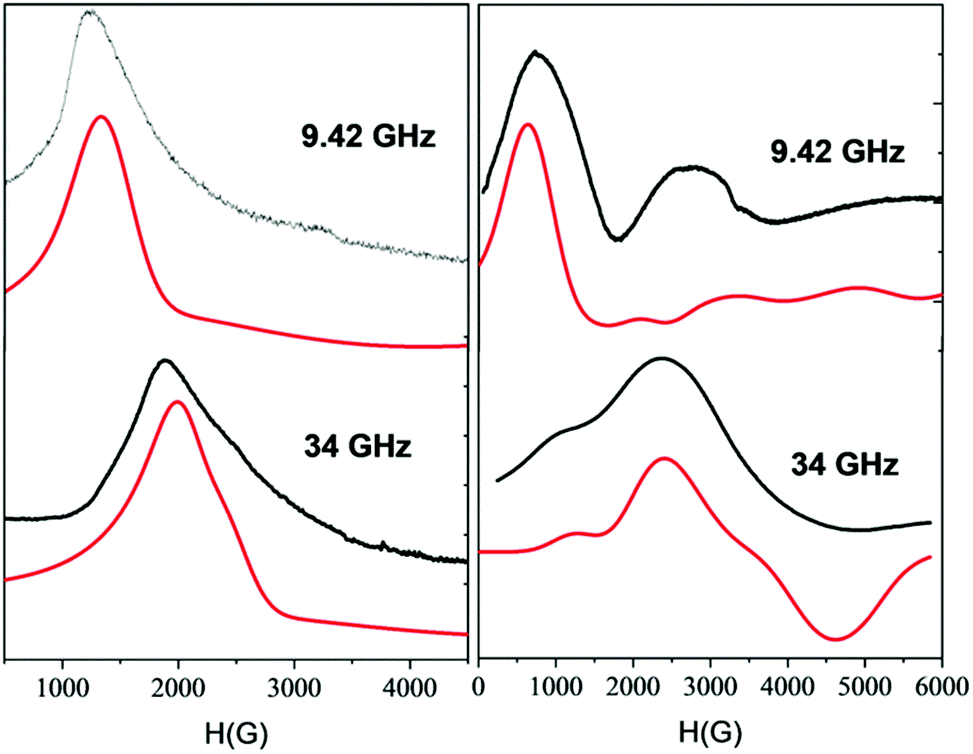
The non-symmetric nature of the complex [Dy2L6(MeOH)]·MeOH as well as its doped diamagnetic Yttrium analogue [Dy0.14Y1.86L6(MeOH)]·MeOH was investigated using magnetic, EPR and theoretical studies to shed light on the nature of the interaction and magnetization relaxation processes. Rich powder EPR spectra at the X-band and Q-band were obtained from the doped Yttrium complexes Dy@Y2 (figure left), as well as the 1·MeOH dimer of Dy(iii) (figure right). Experimental spectra are shown black and their simulation in red.
We simulated the spectra of the Dy@Y2 complex using an effective spin Seff = 1/2 formalism and an Ising-type signal with gx = gy = 0.1 and gz = 13.5 (red line). The measured gz values are close to the one theoretically calculated for the ground state of one of the DyIII ions (Dy-1, gzz = 14.9). These gz values are indicative of a strongly mixed ground state which was further confirmed in the theoretical calculations of the Dy-1 center.
The exchange interaction between the Dy(iii) ions in the 1·MeOH was calculated assuming a model of two effective spins Seff = 1/2 with the following Hamiltonian.

The g values were obtained from the simulation of the Dy@Y2 system. The X-band and Q-band spectra were simulated with the same set of ferromagnetic parameters: J⊥ = 0.038(3) cm−1 and J‖ = 0.1 cm−1 explaining the low temperature susceptibility data.
Ref.: Dalton Trans., 2022,51, 1985-1994. doi: 10.1039/D1DT04089H
Monitoring of Fe(II) Spin Transition in Cu(II)-Doped Spin-Crossover Nanoparticles
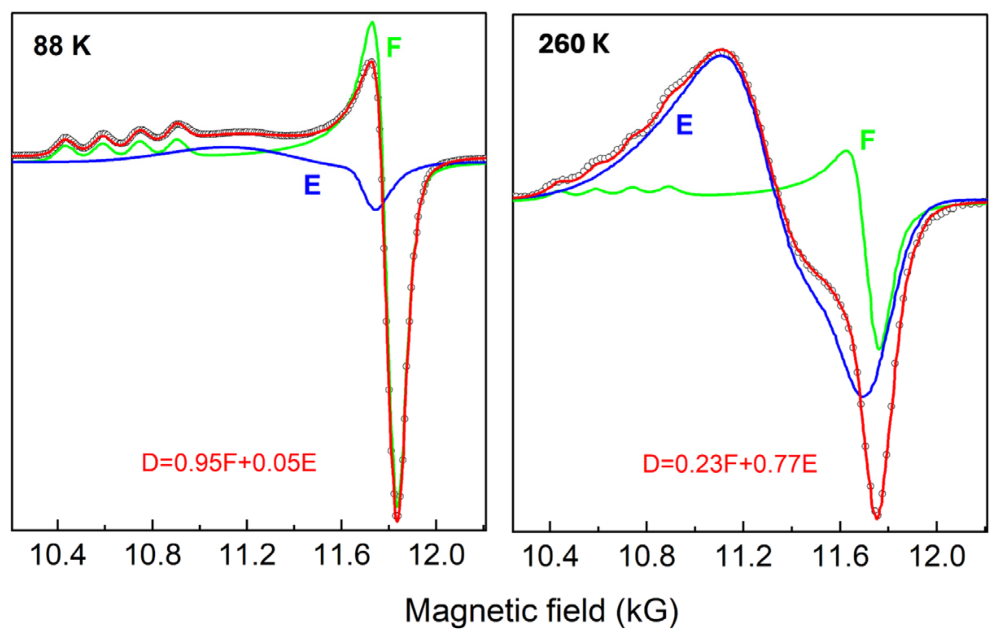
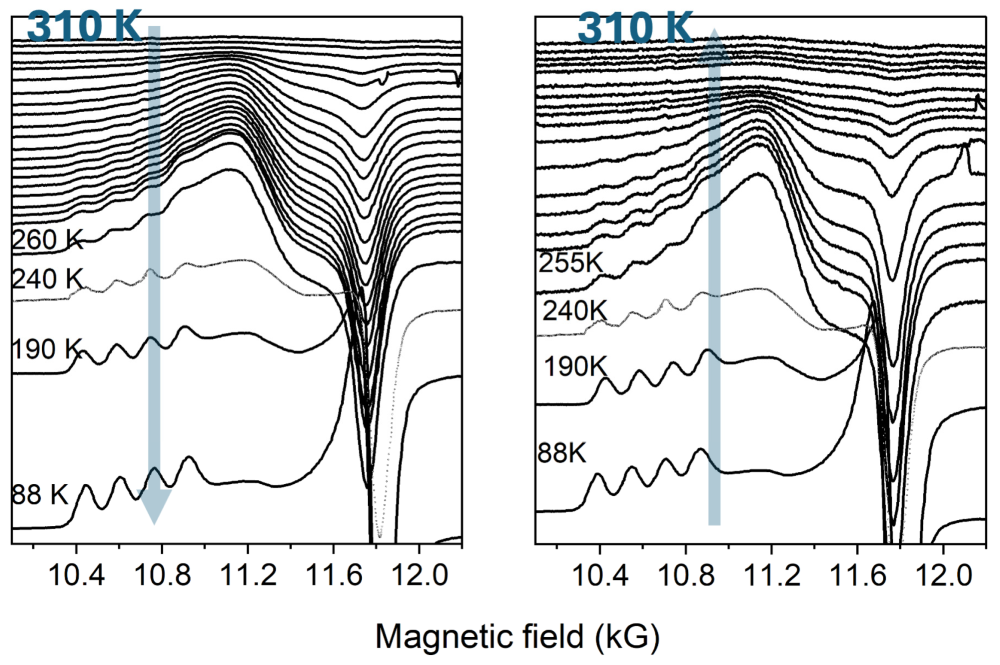
The Fe(II) spin transition in Cu(II)-doped 1-D spin-crossover (SCO) nanoparticles of the type [Fe1−xCux(NH2trz)3]Br2 and synthesized using a reverse micellar approach was followed. EPR spectroscopy provided insights into the structural changes and spin-state transitions, revealing that the spin transition occurs in domains populated by ions of the same spin state. The Cu(II) ions displayed different spectral characteristics depending on whether they were in high-spin or low-spin domains of Fe(II). The EPR spectra analysis indicated that the Cu2+ ions in low-spin domains exhibited an asymmetric axial spectrum with a hyperfine structure. In contrast, those in high-spin domains showed broadened, featureless spectra due to spin–spin interactions with Fe2+ ions.
The top figure shows temperature-dependent EPR spectra of the Cu-doped sample in both heating (88–310 K) and cooling fashion (310–88 K).
The bottom figure shows spectral fitting (red line designated D) at two different temperatures, 88 and 260 K, in the heating mode, based on the composition of two components: (i) component F (green line) in which Cu(II) is in a tetragonally distorted octahedral environment with g parallel exhibiting the nuclear hyperfine splitting and (ii) component E (blue line) in which the Cu(II) signal appears significantly broadened with no discernible hyperfine splittings. The experimental spectra are presented as open cycles.
Ref.: Molecules 2025, 30(6), 1258. doi: 10.3390/molecules30061258