
Very thin Frequency Selective Surfaces and Waveguide Filters
Frequency Selective Surfaces (FSS) and waveguide filters are important building blocks integrated in a variety of Radio Frequency devices enabling wireless communications. They have significant applications in Satellite Communications, Radar and 5G/6G wireless technologies, and others. Pass-band filters, in particular, allow complete transmission of electromagnetic waves in selected frequency bands, while blocking transmission outside these bands.
We present a novel architecture for very thin pass-band FSS and waveguide filters, based on resonantly transparent super-thin printed screens, transversely placed on the direction of propagation of electromagnetic waves or the waveguide axis. The screens are monolithically integrated stacked metal laminate layers obeying Babinet-Duality, i.e., each layer is the negative metallization print of each adjacent layer along the propagation axis. We provide two optimized designs of such filters, which are very thin relative to their performance, operating both as FSS or as finite screens inside a rectangular waveguide.
We have developed a fully analytical method for calculating the electromagnetic response of such FSS systems and for deriving the designs that optimize their performance. This method can be applied either for laterally infinite FSS, as well as for corresponding screens inserted within a rectangular waveguide to operate as a waveguide filters, and the design are scalable to any microwave or mm-wave frequencies. We have also simulated the electromagnetic response of these designs using the ANSYS HFSS full-wave electromagnetic simulator. We show an optimized printed monolithic 3-layer FSS design, and compare analytical and numerically simulated responses for this FSS filters, in figures 1 and 2 below. We obtain good agreement between analytical and numerical results, thus validating the analytical approach and the performance of the corresponding optimized design. In figures 3 and 4 we show the corresponding FSS inserted as a transverse screen within a rectangular waveguide operating in the Ka band, and the corresponding numerically simulated performance.
These results present excellent pass-band behavior while the designs are very thin, compared to the wavelength and very light. Therefore, these monolithically printed architectures are ideal for replacing traditional bulky and heavy waveguide filters which are traditionally based on sparsely placed metallic posts along a substantial length of waveguide sections. These filters can be used to reduce the bulk and weight of RF systems where minimizing these features is necessary, for example for satellite telecommunication payload reduction.
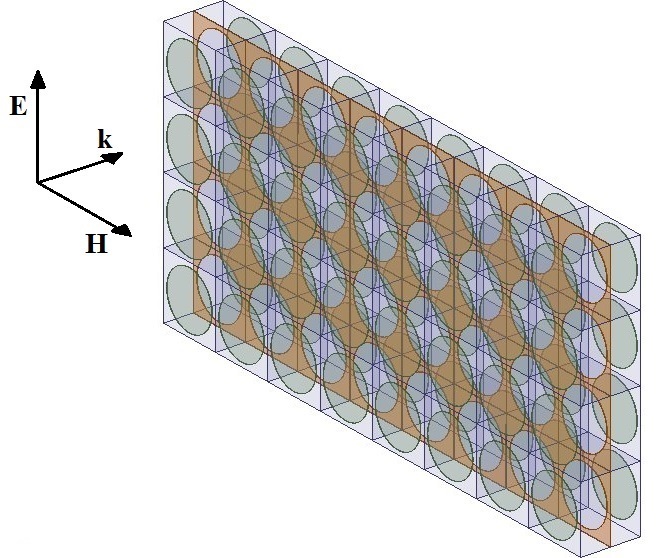
Fig. 1 shows an optimized FSS passband filter in general isometric view under normal plane-wave incidence.
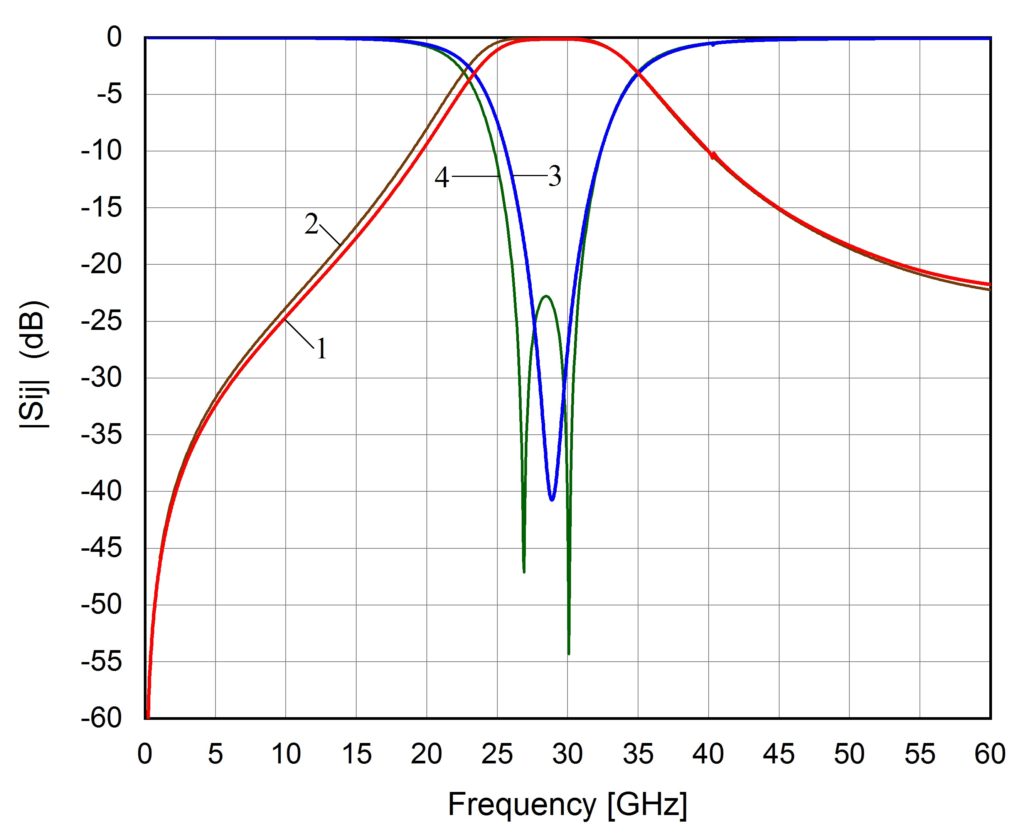
Fig. 2 shows the performance of the FSS passband filter of Fig. 1. Curves [1] (numerical), [2] (analytical): |S21| in dB, power transmission coefficient. Curves [3] (numerical), [4] (analytical): |S11| in dB, power reflection coefficient.
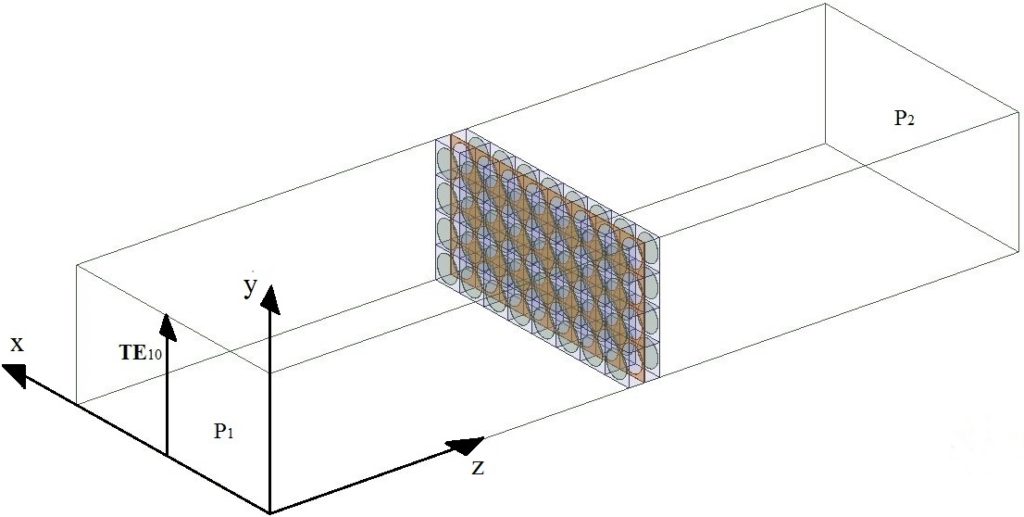
Fig. 3 shows an optimized waveguide passband filter, composed of 8×4 unit cells, inserted inside a metallic Ka-band waveguide. The TE10 excitation on the surface of port P1 and the surface of port P2 are also shown.
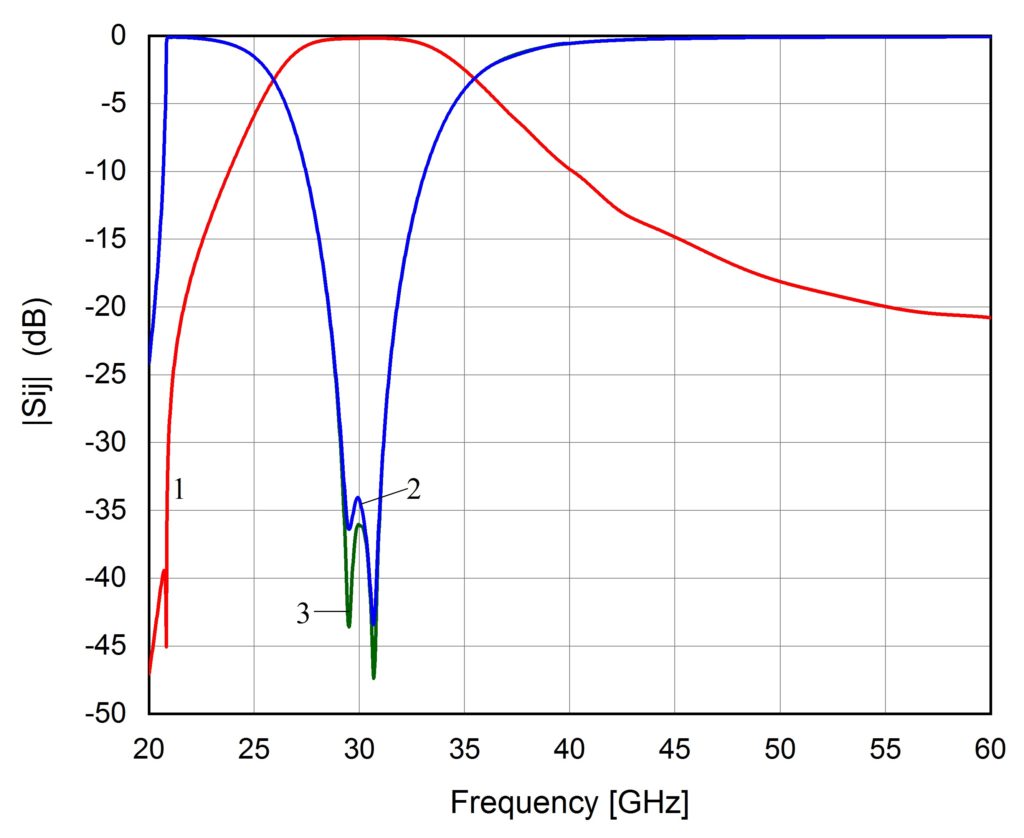
Fig. 4 shows the performance of the waveguide passband filter of Fig. 3. Curve [1]: |S21| in dB, power transmission coefficient. Curve [2]: |S11| in dB, power reflection coefficient from port 1. Curve [3]: |S22| in dB, reverse power reflection coefficient from port 2.