
Chimera states and complex synchronization patterns in adaptive neural networks
Chimera states are hybrid spatiotemporal patterns in networks of identical, coupled oscillators where some units behave synchronously or coherently (phase-locked) while others act asynchronously (incoherently), see Fig. 1. Named after the Greek mythological monster Chimera, these states represent a broken symmetry where order and disorder coexist. In the case of non-adaptive coupling, our recent studies investigate the emergence of chimera states in networks of coupled neuronal oscillators arranged in 1D (ring), 2D (torus), 3D (hypertorus) and fractal dimensions. We show that the chimera multiplicity (number of coherent and incoherent domains) depends on the network connectivity and the coupling strength as well as the dynamics on the nodes of the network, i.e., on the parameters of the nonlinear neuronal oscillators, see Refs. [1] and [2].
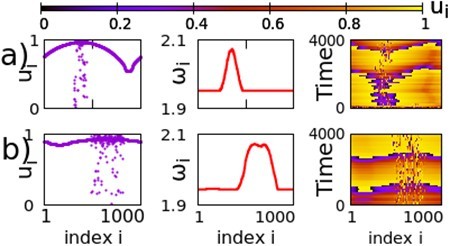
Fig. 1 Chimera states in a 1D ring with one coherent and one incoherent domains in Leaky Integrate-and-Fire (LIF) networks without adaptive linking: potential profile (left), mean phase velocity profiles (center) and spacetime plots (right). Chimera formations are recorded with : a) a small coupling range, R = 80, and b) a large coupling range,
R = 200.
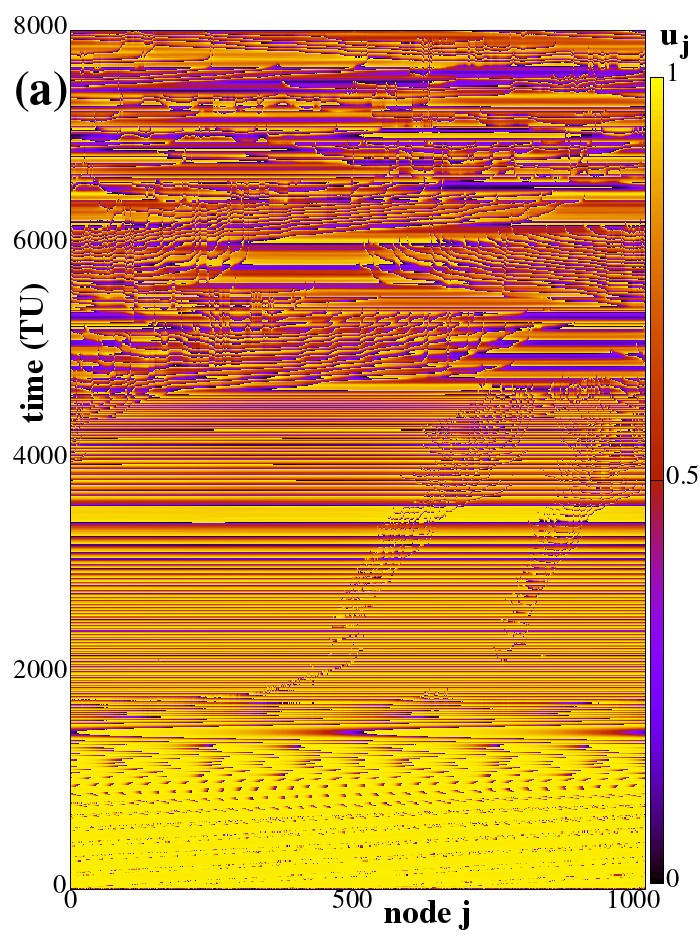
Adaptive coupling in networks of coupled neurons has gained recent attention due to the many applications both in biological and in artificial neural networks, where adaptive coupling or synaptic plasticity is considered as a key factor in learning processes. In recent studies we apply adaptive connectivity rules in networks of nonlinear neural oscillators, like FitzHugh-Nagumo (FHN) and Leaky Integrate-and-Fire (LIF) models. Adaptive coupling can be realized via Hebbian learning often adjusted by the Oja rule to prevent the network link weights from growing without bounds. Our investigations demonstrate that during the adaptation process the FHN and LIF networks undergoes adaptive transitions realizing traveling waves, synchronized states and chimera states transiting through various multiplicities (see Fig. 2). These transitions become more evident when the time scales governing the coupling dynamics are much slower than the ones governing the nodal dynamics (nodal potentials). Namely, when the coupling time scales are slow, the network has the time to realize and demonstrate different synchronization regimes before reaching the final steady state. The transitions can be observed not only in the spacetime plots (as in Fig.2) but also in the abrupt changes of the average coupling weights as the networks evolves in time. Regarding the asymptotic coupling distributions, we show that the limiting average coupling strengths follow inverse power laws with respect to the Oja parameter (also called "forgetting" parameter) which balances the learning growth. We also report abrupt transitions in the asymptotic coupling strengths when the parameters related to adaptive coupling crosses from fast to slow time scales, see refs. [3],[4].
Further studies are needed to investigate whether the transitions in adaptive synchronization depend on the system size, the type of connectivity and the parameters of the nonlinear oscillators. Applications are envisaged in biomedicine, in view of recent reports on the emergence of complex synchronization phenomena and chimera states at the onset of epileptic crises.
Recent Literature
- A. Provata, J. Hizanidis, K. Anesiadis and O. Omel’chenko, Mechanisms for bump state localization in two-dimensional networks of leaky integrate-and-fire neurons Chaos 35, 033146, 2025. https://doi.org/10.1063/5.0244833
- A Provata, Amplitude chimeras and bump states with and without frequency entanglement: a toy model, Journal of Physics: Complexity, 5, 025011, 2024, https://doi.org/10.1088/2632-072X/ad4228
- A. Provata, G.C. Boulougouris and J. Hizanidis, Synchronization transitions in spiking networks with adaptive coupling, Chaos, Solitons & Fractals, 200, 117128, 2025, https://doi.org/10.1016/j.chaos.2025.117128.
- A. Provata, G.C. Boulougouris and J. Hizanidis, Adaptive transitions in FitzHugh–Nagumo networks with Hebb–Oja coupling rules, Journal of Statistical Mechanics: Theory and Experiments, 044004, 2026, https://doi.org/10.1088/1742-5468/ae5c93.